Percutaneous tendon debridement for hip tendon conditions — TenJet® procedure guide
Percutaneous hip tenotomy using TenJet® offers a minimally invasive way to treat degenerated hip tendons — addressing the root cause of pain without open surgery or general anesthesia.
Find a Specialist Learn MoreFirsthand Account
This TenJet patient describes what a percutaneous tenotomy involved and how their recovery progressed.
TenJet Patient Testimonial
Video courtesy of HydroCision, Inc., the maker of TenJet®. Individual results vary; this patient's experience is not a guarantee of outcome. Talk with a specialist about whether the procedure is appropriate for you.
Tenotomy refers to the cutting or debridement of a tendon. In the context of TenJet® percutaneous tenotomy, the procedure uses high-pressure fluid mechanics to precisely remove degenerated tendon tissue without cutting healthy fibers or requiring open incisions.
Hip tenotomy addresses conditions of the major hip tendons — including the gluteal tendons (gluteus medius and minimus), hip flexor tendons (iliopsoas), and the proximal hamstring tendons — where degeneration is causing persistent pain.
When a tendon undergoes chronic degeneration (tendinopathy), normal collagen fibers are replaced by disorganized, weak tissue. This degenerated tissue is painful, prone to re-injury, and lacks the blood supply needed to heal on its own without intervention.
Traditional surgical tenotomy requires open incisions and carries risks of anesthesia, infection, and prolonged recovery. Percutaneous tenotomy using TenJet® achieves the same goal — removing degenerated tissue — through a small incision with local anesthesia only, in approximately 15 minutes.
TenJet® by HydroCision is the leading device for percutaneous tendon debridement, used by specialists across the country for hip, shoulder, elbow, plantar fascia, and other tendon conditions.
Official TenJet® product page: hydrocision.com/product/tenjet/
TenJet® hip tenotomy is appropriate for a range of hip tendon degenerative conditions, including:
Your specialist will confirm which tendon or tendons are involved through clinical exam and diagnostic imaging before recommending the procedure.
Official demonstration video from HydroCision, the maker of TenJet, plus a look at how tendinitis differs from the deeper tissue degeneration TenJet is designed to treat.
TenJet Gluteal Tendinopathy Minimally Invasive Tenotomy


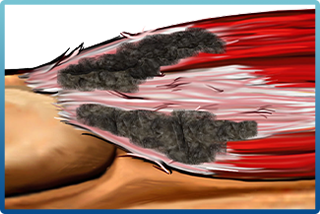
Diagrams and video courtesy of HydroCision, Inc.
Common Questions
Literally, cutting of a tendon. In this context it means selectively removing the degenerated portion of a tendon while leaving healthy fibers intact, performed through a small incision.
Percutaneous means working through a small puncture-sized incision under imaging rather than opening the area surgically. That difference drives the shorter, less involved recovery.
Standard practice is local anesthesia with the patient awake. Sedation is not typically required for a procedure of this length in an outpatient setting.
Only the diseased portion identified on ultrasound. In one published Achilles case the physician estimated roughly 75 percent of the diseased tendon was removed in a single session.
This information is general and is not medical advice. Whether any procedure is appropriate for you can only be determined by a physician who has examined you and reviewed your imaging.